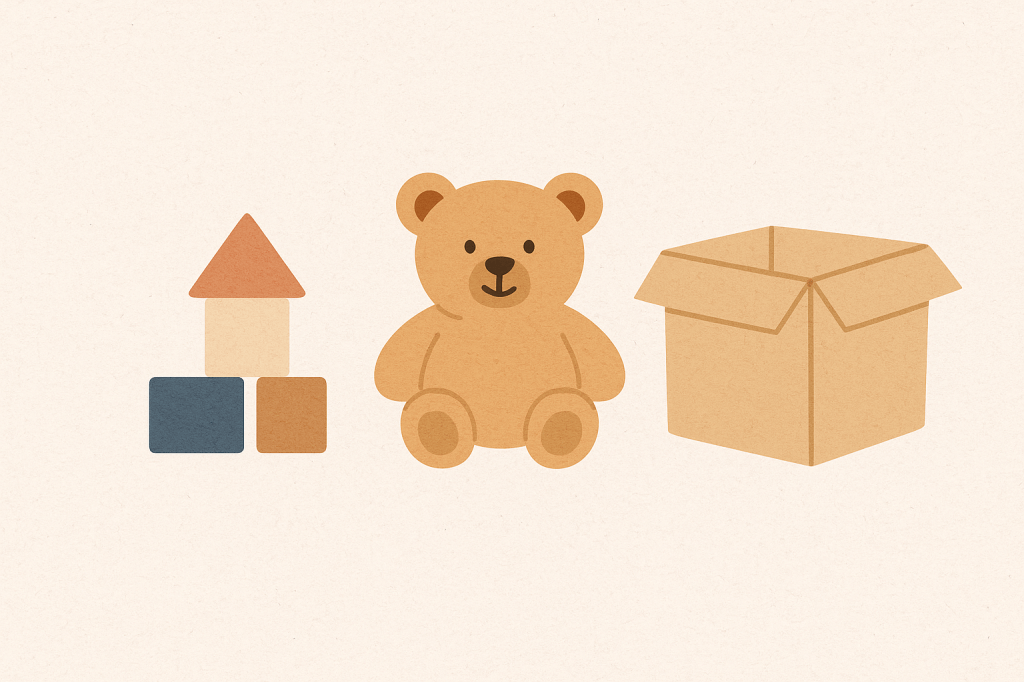
Not all toys are created equal, and I don’t mean quality or price. I’m talking about the kind of play they encourage. Passive toys, like blocks, dolls, or stacking cups, may seem “boring” to adults. No lights. No music. No batteries. But guess what? That’s exactly why they’re magic.
Because passive toys do one very important thing:
They let the child lead the play.
They don’t talk, move, or sing on their own. So who has to do the imagining, the storytelling, the experimenting? Yep, the child.
When a toy is loud, flashy, and does all the “playing” for them, kids don’t really have to do much. They press a button, it lights up. Done. But with a passive toy? Their brain and body get to take the wheel. They become the sound effects, the motor, the storyteller, the problem-solver.
Think of it like this:
A stuffed animal doesn’t sing a song, it becomes the baby’s best friend, patient, or pirate sidekick.
A wooden train set doesn’t move on its own, it becomes a track-building, physics-testing adventure.
A pile of magnet tiles doesn’t instruct, you get the full-blown construction crew in action.
And that’s where development blooms, creativity, motor skills, focus, independence, and all those brain-building moments we want for our kids.
So when people say “less is more,” this is what they mean.
It doesn’t have to be expensive or fancy. A spoon and a cardboard box? Passive toys. And somehow still the best fun ever.
Give your child room to do, not just watch.
Passive toys.
Active minds.
Happy childhood.
 layersofbeca.com